


 info@luxorlocalguide.com
 +20122-176-9255

Full day in Aswan
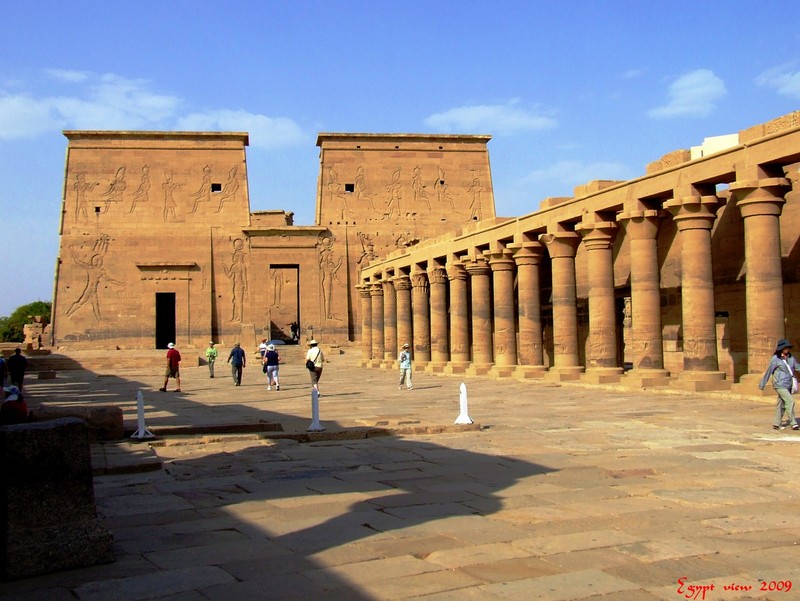
Philae temple
Aswan Low Dam

Philae flooded by the Aswan Low Dam in 1906.
In 1902, the Aswan Low Dam was completed on the Nile River by the British. This threatened many ancient landmarks, including the temple complex of Philae, with being submerged. The dam was heightened twice, from 1907–12 and from 1929–34, and the island of Philae was nearly always flooded. In fact, the complex was not underwater only when the dam‘s sluices were open, from July to October.
It was postulated that the temples be relocated, piece by piece, to nearby islands, such as Bigeh or Elephantine. However, the temples’ foundations and other architectural supporting structures were strengthened instead. Although the buildings were physically secure, the island’s attractive vegetation and the colors of the temples’ reliefs were washed away. Also, the bricks of the Philae temples soon became encrusted with silt and other debris carried by the Nile.
Rescue project
In 1960 UNESCO started a project to try to save the buildings on the island from the destructive effect of the ever increasing waters of the Nile.
The temples had been practically intact since the ancient days, but with each inundation the situation worsened and in the sixties the island was submerged up to a third of the buildings all year round. First of all a large coffer dam was built, constructed of two rows of steel plates between which a million cubic meters of sand was tipped. Any water that seeped through was pumped away.
Next the monuments were cleaned and measured, by using photogrammetry, a method that enables the exact reconstruction of the original size of the building blocks that were used by the ancients. Then every building was dismantled into about 40,000 units, and then transported to the nearby Island of Agilkia, situated on higher ground some 500 metres (1,600 ft) away.
High Dam
In the middle of the arid Egyptian desert lies one of the largest embankment dams in the world. It is called the Aswan High Dam, or Saad el Aali in Arabic, and it captures the mighty Nile River in the world’s third largest reservoir, Lake Nasser. Before the dam was built, the Nile River overflowed its banks once a year and deposited four million tons of nutrient-rich silt on the valley floor, making Egypt’s otherwise dry land productive and fertile. But there were some years when the river did not rise at all, causing widespread drought and famine. In 1952, Egyptian president Gamal Abdal-Nasser pledged to control his country’s annual flood with a giant new dam across the Nile River. His plan worked.
The Aswan High Dam captures floodwater during rainy seasons and releases the water during times of drought. The dam also generates enormous amounts of electric power — more than 10 billion kilowatt-hours every year. That’s enough electricity to power one million color televisions for 20 years!Unfortunately, the dam has also produced several negative side effects. In order to build the dam, 90,000 Egyptian peasants had to move. To make matters worse, the rich silt that normally fertilized the dry desert land during annual floods is now stuck at the bottom of Lake Nasser! Farmers have been forced to use about one million tons of artificial fertilizer as a substitute for natural nutrients that once fertilized the arid floodplain.
Unfinished obelisk
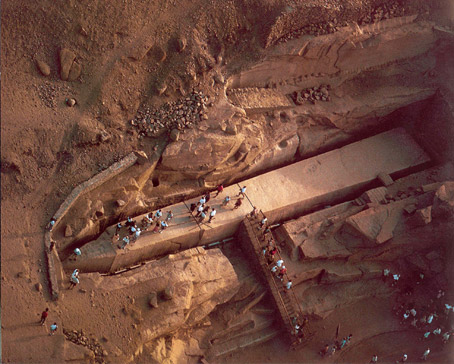
One of the most famous stones left behind is the ‘Unfinished’ Obelisk, taller than any known obelisk ever raised. Quarrymen apparently abandoned the obelisk when fractures appeared in its sides. However, the stone, still attached to bedrock, gives important clues to how the ancients quarried granite. Much of the red granite used for ancient temples and colossi came from quarries in the Aswan area (500 miles south of Cairo). The Unfinished Obelisk still lies where a crack was discovered as it was being hewn from the rock. Possibly intended as a companion to the Lateran Obelisk, originally at Karnak, now in Rome, it would have measured 120-feet and weighed over 1150 tons when complete.The obelisk’s creators began to carve it directly out of bedrock, but cracks appeared in the granite and the project was abandoned. Originally it was thought that the stone had an undetected flaw but it is also possible that the quarrying process allowed the cracking to develop by releasing the stress. The bottom side of the obelisk is still attached to the bedrock. The unfinished obelisk offers unusual insights into ancient Egyptian stone-working techniques, with marks from workers’ tools still clearly visible as well as ochre-coloured lines marking where they were working.
Feluca ride :one hour tour on the feluca to see the beauty of Aswan.


