


 info@luxorlocalguide.com
 +20122-176-9255

Luxor West Bank Full Day
| Items | price |
|---|---|
| Tour Guiding Service | |
| Transport for 2 people | |
| Entrance Fees per person | |
Valley of the Kings
The Valley of the Kings (what used to be Thebes) lies about 7km from the Nile on the west bank, and must have been one of the most amazing discoveries made in Egypt. It was here that bodies of kings such as Tutankhamoun , Ramses II, Ramses IV, Tutmose III and many other kings once lay. The idea for building this kind of burial ground is thought to have originated with the Pharaoh Tutmose I, who owing to the frequency of tomb robbings (even in those days), decided to have his tomb concealed in a place far away from his mortuary temple and not near the temple as past Pharaohs had been doing. The Pharaohs that followed did the same — hence changing a tradition that had been going on for close to 2000 years. Within the tombs and along the walls, inscriptions from the Book for the Dead provided instructions for how the Pharaoh may have a safe trip to the next world and how to avoid the dangers that lay on the way. Although not all the tombs are always open to visitors, the more interesting ones usually are. These tombs are also electrically lighted and give a more impressive image, exposing more of the artistic detail. The tombs in the valley of the kings belong to the Eighteenth, Nineteenth and Twentieth Families. They are 62 tombs, including some small tombs which are not considered royal. The total tombs that can be visited are seventeen. Some of them are really worth visiting, such as: – Tomb No. 62 belonging to king Tutankhamoun and No. 35 belonging to king Amenhotob II, for they are characterized by their lovely entrances, passages and their colorful drawings. -Tomb No. 17, which belongs to King Siti I, is considered the most beautiful tomb in the whole valley. -Tomb No. 8 is king Merenbetah’s, and is marked by its beautiful coffin and unique drawings. -Tomb No. 11, belonging to King Ramsis III, is known for its splendor and luxury. -Tomb No. 9, which belong to Ramsis the Fifth, was seized by king Ramsis the Sixth and is considered a good example of Ramsis’ late art. -Tomb No. 6, which is the tomb of King Ramsis the Ninth, is the last tomb built in the valley.
Hatshepsut Temple
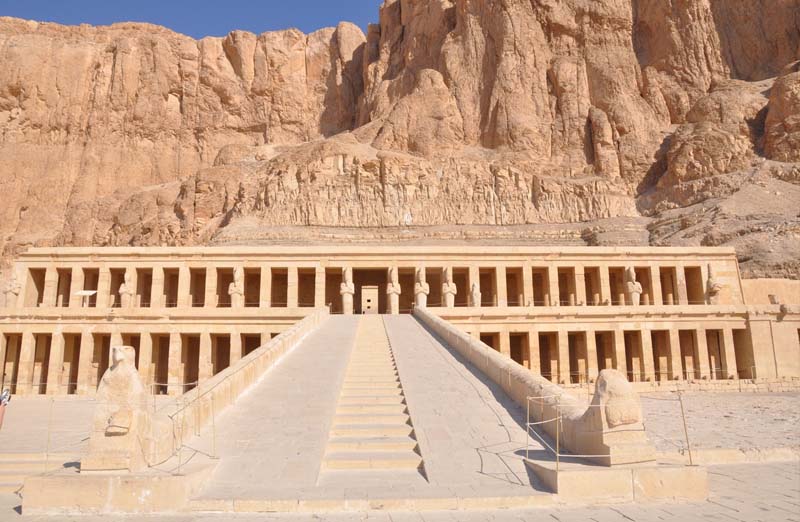
The mortuary temple of Queen Hatshepsut is one of the most dramatically situated in the world. The queen’s architect, Senenmut, designed it and set it at the head of a valley overshadowed by the Peak of the Thebes, the “Lover of Silence,” where lived the goddess who presided over the necropolis. A tree lined avenue of sphinxes led up to the temple, and ramps led from terrace to terrace. The porticoes on the lowest terrace are out of proportion and coloring with the rest of the building. They were restored in 1906 to protect the celebrated reliefs depicting the transport of obelisks by barge to Karnak and the miraculous birth of Queen Hatshepsut. Reliefs on the south side of the middle terrace show the queen’s expedition by way of the Red Sea to Punt, the land of incense. Along the front of the upper terrace, a line of large, gently smiling Osirid statues of the queen looked out over the valley. In the shade of the colonnade behind, brightly painted reliefs decorated the walls. Throughout the temple, statues and sphinxes of the queen proliferated. Many of them have been reconstructed, with patience and ingenuity, from the thousands of smashed fragments found by the excavators; some are now in the Cairo Museum, and others the Metropolitan Museum of Art, New York.
Valley of the Queens
A short distance from the Valley of the Kings lies the Valley of the Queens. It lies at the southern end of Theban cemetery and includes a number of royal tombs belonging to the Nineteenth and Twentieth Families. The total number of these tombs is seventy, yet most of them are unimportant, void of writings or inscriptions. This valley can be reached either through Habo town or its cathedral. As far as we know, King Ramsis I of the Nineteenth Family was the first to build a tomb for his wife in the Valley of the Queens. This is tomb number 38 which belongs to Set Raa. King Ramsis II also buried his wife, the beautiful Nefetari there along with three of his daughters. It is also known that Ramsis III from the Twentieth Family buried his wife Isis, and four of his sons. As for the rest of the tombs, they perhaps hide the families of the kings who followed King Ramsis III — yet afterwards, the valley seems to have been abandoned as a royal settlement.
Habu Temple
All along the border between the fertile section of the Valley and the hills we find Temples and one palace. The southern most temple is that of Ramesses III located at Medinet Habu . The palace, one of the southernmost monuments in the Valley, is at Malkata , just south of Deir el-Medina, and belonged to Amenhotep III , but was probably also inhabited by a few of his successors. At one time, it was a huge complex.
Tombs of the Nobles
The Tombs of the Nobles actually comprises a number of distinct areas on the West Bank at modern Luxor (Ancient Thebes). These areas mostly lie in five different regions. Farthermost north is an area known as el-Tarif, where large, row tombs were dug during the late Second Intermediate Period and early Middle Kingdom. Just south of el-Tarif is Dra Abu el-Naga, which is a hillside with about 80 numbered tombs most belonging to priests and officials of the 17th through 20th dynasty, including some rulers of the 17th dynasty. Just southwest of Dra Abu el-Naga is an area called El-Assasif, where there are 40 tombs, mostly from the New Kingdom and later. Just south of El-Assasif is El-Khokha, a hill with five Old Kingdom tombs and 53 numbered tombs from the 18th and 19th dynasty.
Colossi of Memnon
These two huge statues of Amenhotep III originally sat in front of the mortuary temple of the king. Unfortunately, this temple was destroyed throughout the centuries. It is believed that it was built of white sandstone, gold and silver. The statues show Amenhotep seated on his throne with the two Nile gods of upper and lower Egypt uniting the two lands, at his sides. It is also interesting to know that on the right of each statue appears a small figure of Queen Tiye, wife of Amenhotep III and on the left Queen Mutemua, his mother. The colossi are made of sandstone. Part of the north colossus fell in the earthquake of 27 BC. During the Roman period, this site became very popular. Authors and travellers wrote verses on the stone.


